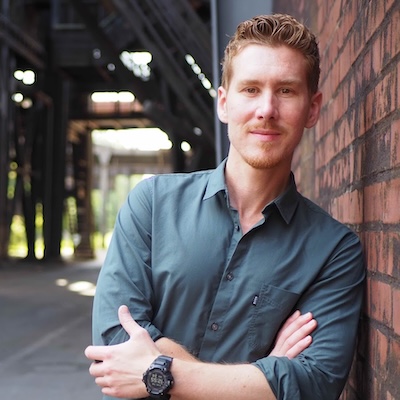
Sebastian Raschka
Independent AI Researcher, Author & Educator
Independent AI Researcher, Author & Educator
We are excited to announce Sebastian Raschka as a keynote speaker at PyCon DE & PyData 2026 in Darmstadt, April 14–16.
Sebastian Raschka is one of the most recognized voices in practical LLM research and education worldwide. His keynote will walk through the full path of developing large language models with Python — from the core building blocks of model architectures and training loops to scaling data and computation across modern hardware. He will also reflect on Python's evolving role in the AI ecosystem as new backends take over the heavy lifting.
The landscape has shifted. In 2023, the conversation was about what LLMs can do. In 2024, it was about how to use them via APIs. In 2026, the real question is: how do they actually work, and how do you build, train, fine-tune, and scale them yourself?
This is exactly where Sebastian Raschka operates. His book Build a Large Language Model (From Scratch), published in 2024, has become the go-to resource for practitioners who want to understand LLMs at the implementation level. Written entirely in pure PyTorch — no high-level framework wrappers, no black boxes — it walks readers through building a GPT-style model step by step. The accompanying GitHub repository has amassed over 86,000 stars and 13,000 forks, making it one of the most starred machine learning repositories on GitHub.
His follow-up, Build a Reasoning Model (From Scratch), published in 2025, picks up where the first book left off. Starting from a pre-trained base model, it implements reasoning capabilities through inference-time scaling, reinforcement learning with verifiable rewards (RLVR), and distillation — the very techniques that power models like DeepSeek R1 and GPT-5 Thinking.
These are not theoretical treatments. They are hands-on implementations that run on consumer hardware. For a conference that brings together Python engineers and data scientists, the timing could not be better: Raschka's keynote addresses exactly the skill gap the community is facing right now.
PyCon DE & PyData sits at the intersection of the Python ecosystem and the data/AI world. One of the most consequential questions for this community is: what role will Python continue to play as AI infrastructure matures?
Sebastian Raschka has announced that his keynote will explicitly address this. Python remains the language of experimentation, prototyping, and research. But underneath, the heavy lifting increasingly moves to Rust, C++, and custom CUDA kernels. Understanding where Python remains essential — and where it hands off to lower-level systems — matters for everyone building AI products today.
Raschka brings a unique perspective here. All his books and tutorials use pure PyTorch by design, to maximize understanding. At Lightning AI, he co-developed LitGPT, an open-source library for pre-training, fine-tuning, and serving all major LLM architectures (Llama, Gemma, Phi, and others) — essentially a production-grade NanoGPT with multi-GPU support. His long-running open-source library mlxtend, with over 5,000 GitHub stars, has been a fixture in the Python ML ecosystem for more than a decade.
This is someone who has thought deeply about Python's strengths and limitations in AI — not in the abstract, but through years of building real tools and training real models.
Sebastian Raschka's career path reflects a trajectory familiar to many in our community. After studying at the University of Würzburg in Germany, he completed his PhD in Computational Biology at Michigan State University, then held a tenure-track position as Assistant Professor of Statistics at the University of Wisconsin-Madison. In 2022, he joined Lightning AI — the startup behind PyTorch Lightning — and ultimately resigned his professorship to focus fully on the intersection of LLM research, open-source development, and education.
Today, Raschka runs his own research lab, RAIR Lab LLC (Raschka AI Research), as an independent researcher, author, and consultant. He holds no corporate affiliation that would shape his keynote into a product pitch. What the audience in Darmstadt will get is a technically deep, honest assessment of where LLM development stands — from someone who is actively doing the work.
For a conference that values open source and community-driven knowledge, this independence matters.
Sebastian Raschka is not only a researcher and practitioner — he is one of the most effective communicators in the field. His newsletter Ahead of AI, published on Substack, has grown to over 168,000 subscribers, placing it among the top technology publications on the platform. It features technical deep dives into LLM architectures, curated research paper roundups, and annual state-of-the-art reviews that are widely referenced across the ML community.
In February 2026, just weeks before our conference, Raschka appeared on the Lex Fridman Podcast (#490) alongside Nathan Lambert for a 4.5-hour conversation on the state of AI in 2026 — covering everything from the LLM landscape and training paradigms to AGI timelines and the future of compute.
His track record on the conference circuit is equally substantial: a deep learning workshop at PyCon US 2024, tutorials at SciPy 2024, a presentation at the PyTorch Conference 2025, and a workshop at NeurIPS 2023. He maintains over 12,300 academic citations on Google Scholar and has authored a 17-hour video course that mirrors his LLM book chapter by chapter.
PyCon DE & PyData 2026 is bringing a speaker to Darmstadt whose work is shaping how the global ML community learns, builds, and thinks about large language models.
Based on Raschka's own description and his current body of work, attendees can expect:
Whether you are building LLM-powered applications, contributing to open-source ML tools, working in data science, or simply looking to understand the technology that is reshaping the industry — this keynote offers a rare opportunity to hear from someone who bridges research, implementation, and education like few others.
📅 PyCon DE & PyData 2026 — April 14–16, Darmstadt, Germany
Get Your Tickets